- Editor

- CategoryEssay
- DateJanuary 4, 2026
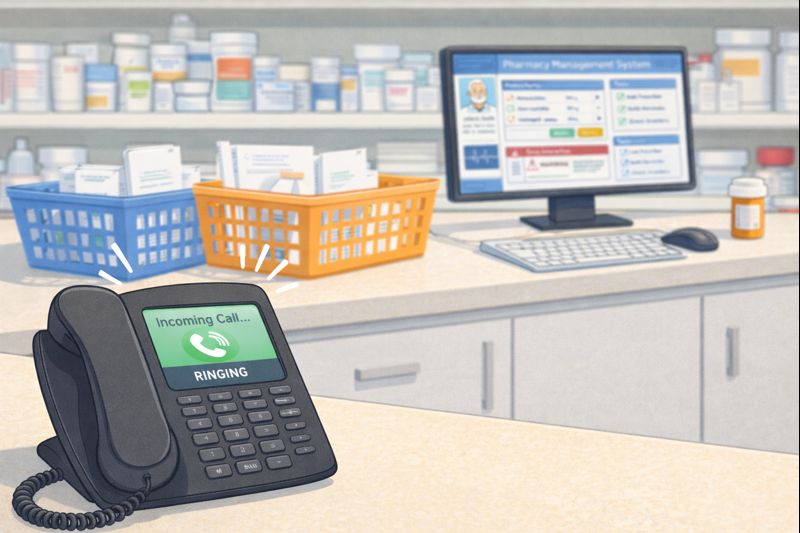
In a community pharmacy, the phone rings constantly. Patients call to check prescription status, prescribers call to clarify directions, insurance plans call about coverage questions, and caregivers call seeking reassurance. Each call may seem brief and harmless on its own, but together they represent one of the most significant and least understood drivers of workload, inefficiency, and stress in pharmacy operations.
The true cost of a phone call is not measured in minutes. It is measured in interruptions, downstream errors, lost productivity, and missed opportunities that ripple throughout the entire workday.
Time Spent Is Only the Beginning
A typical pharmacy phone call may last anywhere from two to seven minutes. On paper, that does not appear excessive. In practice, however, the call itself is only one part of the time cost.
Before answering, a staff member must disengage from an existing task. After the call ends, that same staff member must reorient themselves, recall where they left off, and reestablish focus. This transition period often takes longer than the call itself, particularly for tasks that require concentration, such as prescription verification or clinical review.
When this process repeats dozens or hundreds of times per day, the cumulative time loss becomes substantial. Even highly efficient pharmacies find that phone calls fragment the day into short, disjointed segments that make sustained productivity difficult.
Interruptions and Cognitive Load
Pharmacy work relies heavily on attention and accuracy. Verifying medications, checking interactions, and counseling patients require uninterrupted focus. Phone calls disrupt that focus repeatedly.
Each interruption increases cognitive load. Staff must mentally switch contexts, often from a technical or clinical task to a conversational one and then back again. Research across many industries shows that frequent context switching increases mental fatigue and reduces accuracy, especially in safety-critical environments.
In a pharmacy, this can manifest as slower processing times, increased stress, and a higher likelihood of mistakes that require correction later. The interruption itself is not dangerous, but the environment it creates increases risk.
Downstream Errors and Rework
Phone calls often generate additional work rather than resolving it. A call to check whether a prescription is ready may prompt staff to investigate an insurance issue. A clarification call from a prescriber may require documentation updates and system changes. A patient question about cost may lead to a formulary review or prior authorization inquiry.
Each of these outcomes adds steps to the workflow. If the call interrupts a task midstream, there is also a greater chance that the original task will need to be reviewed or rechecked, creating rework.
Over time, these small inefficiencies compound. The pharmacy may appear busy without making proportional progress, leading to longer queues, delayed pickups, and additional calls from patients seeking updates. The phone volume becomes self-reinforcing.
Opportunity Cost and Lost Capacity
Time spent answering phones is time not spent on other activities. In community pharmacies, this opportunity cost is significant.
Every hour absorbed by phone calls reduces capacity for prescription processing, patient counseling, clinical services, inventory management, or workflow optimization. Even when staffing levels appear adequate, excessive phone volume can create bottlenecks that limit what the pharmacy can realistically accomplish in a day.
This is particularly important as pharmacies expand their role in vaccinations, medication therapy management, and preventive care. These services require planning, documentation, and patient interaction that cannot easily occur in a constantly interrupted environment.
Impact on Patient Experience
Ironically, phone calls intended to improve communication can degrade the overall patient experience. When staff are pulled away from the counter or verification tasks, wait times increase. Missed calls lead to repeated attempts. Frustrated patients may arrive in person without having received answers over the phone, adding pressure to an already busy workflow.
The result is a cycle in which phone calls create delays, delays create more calls, and the pharmacy struggles to break the pattern.
Why Phone Volume Keeps Rising
Several systemic factors have driven increased phone volume in pharmacies. Insurance complexity requires frequent clarification. Prescription shortages prompt patients to check availability. Expanded clinical services generate scheduling and eligibility questions. Telehealth prescribing increases the need for follow-up and verification.
At the same time, many pharmacy systems were not designed to handle high volumes of real-time communication efficiently. As a result, the phone remains the default channel for resolving issues that might otherwise be handled asynchronously or automatically.
The Structural Nature of the Problem
The cost of phone calls is not primarily a staffing issue. Adding more people can help temporarily, but it does not address the underlying dynamics of interruption-driven work. As long as communication relies heavily on synchronous phone conversations, pharmacies will continue to experience fragmented workflows.
This challenge reflects a broader mismatch between modern pharmacy responsibilities and the tools used to support them. Pharmacies have become communication hubs without being structurally designed for that role.