
- Editor

- CategoryEssay
- DateNovember 20, 2025
This essay explores the invisible forces that have reshaped modern pharmacy work, from nonstop phone interruptions to refill complexity and administrative drag. It’s a candid reflection on what needs to change for pharmacies to reclaim focus, sanity, and the work they were trained to do.
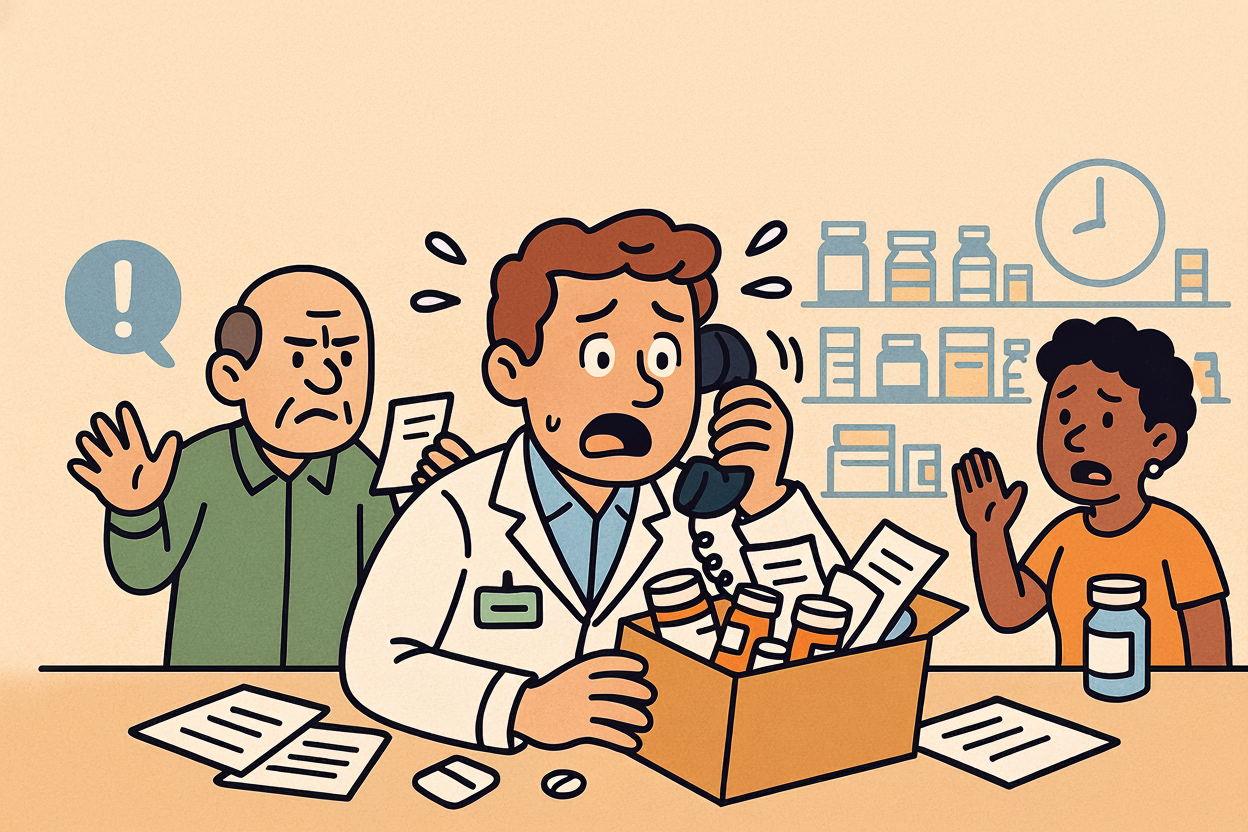
Walk into any independent pharmacy today and the atmosphere feels charged. Phones ring with the urgency of alarms, technicians juggle conversations with patients while trying to finish tasks they started ten minutes ago, and pharmacists jump between verification, counseling, and insurance problems while trying to maintain accuracy. It’s not chaos, exactly. It’s something tighter, more condensed. It’s pressure.
People outside the world of pharmacy often chalk this up to staffing shortages or prescription volume, but those explanations only scratch the surface. What’s actually happening is deeper and more structural. Pharmacies have become operationally heavier every year, accumulating administrative mass like a planet gathering layers of sediment. Eventually the gravity becomes so strong that it bends the entire workday around it.
This piece is my attempt to map out that gravity. To articulate why pharmacies feel so overwhelmed and why the burden isn’t simply a matter of more help needed but the result of a profession transformed by communication, paperwork, and interruptions that nobody designed for.
The Phone: The Unofficial Manager of the Pharmacy
There is an unspoken truth in pharmacy: the phone determines the rhythm of the day more than the PMS does. It’s the real boss. The pharmacy might have a beautifully organized workflow system, but everything dissolves the moment the phone starts ringing.
And it rings constantly.
A phone call is never just a phone call. It is an interruption that forces someone to abandon the task they were focused on and start over mentally. Pharmacy work requires precision, but the environment behaves like a notification feed on fast-forward. A technician labels a prescription, the phone rings. A pharmacist begins verifying a complicated order, the phone rings. Someone finally catches up on the queue, the phone rings three times in a row like a machine gun.
The most damaging part isn’t the call itself but the reset afterward. Human focus does not snap back like a rubber band. It drifts. It takes time. And when this happens dozens or even hundreds of times a day, the accumulation becomes its own source of fatigue.
Pharmacies don’t just answer phone calls. They live inside them.
Refills: The Slow Drip That Becomes a Flood
Refill management sits quietly at the center of pharmacy operations, pretending to be simple. It isn’t. Refills are fragmented, slow moving, and oddly fragile. One refill request can stretch across multiple days and multiple parties, and the pharmacy is the one holding the thread the entire time.
On any given afternoon a pharmacy might be caught in a tangle of last fill dates, prescriber approvals, insurance quirks, synchronization headaches, and patients calling to ask why their refill is taking so long. The work isn’t difficult in the technical sense, but it’s relentless, like being pecked by a thousand small tasks instead of hit by one big one.
The strangest part is how invisible refill complexity is to everyone except the people doing it. From the outside refills look like a button click. Inside a pharmacy refills are their own ecosystem with its own weather patterns, storms and all.
The Prior Authorization Vortex
There is probably no greater source of collective frustration in the pharmacy world than prior authorizations. PAs feel like the DMV of pharmacy work: nobody wants to deal with them, everyone is forced to, and the process seems specifically engineered to drain time and morale.
A PA is never linear. It is a chain reaction. It begins with a denial, which triggers a scramble to find forms, call providers, gather documentation, send faxes, and wait for replies that might come today, tomorrow, or never. Meanwhile a patient is either standing at the counter or calling repeatedly to ask for updates. There is pressure from every direction, and none of the pressure aligns.
What makes PAs especially painful is not the time they consume but the emotional energy they extract. They land in the middle of the busiest moments. They demand immediate attention. They tangle clinical care with administrative friction. They turn a pharmacist into an insurance liaison without so much as a warning.
The vortex is real and everyone feels it.
Vaccine Seasons and the Sudden Storms They Bring
Pharmacies didn’t gradually become vaccination centers. It happened abruptly, like a door slamming open. COVID ushered in a new era of pharmacy responsibility and the system never scaled around it.
Vaccine scheduling is its own operational universe. One moment the calendar is empty; the next, a flood of appointment bookings, cancellations, questions, reminders, and documentation tasks fill the day. Vaccines are clinically straightforward but administratively dense. They generate a wave of communication that pharmacies must absorb instantly, regardless of how busy they already are.
Vaccine season feels like a storm that rolls in without warning, even though everyone knows it’s coming. There is no cushion. The phones get louder. The line gets longer. And everyone inside the pharmacy must somehow stretch further without breaking.
The Paper Mountain Nobody Wants to Climb
Every pharmacy has a quiet mountain of paperwork that accumulates behind the counter. Insurance cards, transfer requests, IDs, doctor notes, medication lists, documents faxed over from providers—each one demands attention. Each one needs to be interpreted and entered correctly. Each one interrupts someone’s workflow at precisely the wrong time.
The irony is that paperwork is both critically important and entirely disconnected from the clinical heart of pharmacy practice. It must be done, yet it pulls pharmacists and technicians away from the work only they can do.
The mountain never shrinks. It simply shifts shape.
Why Hiring Isn’t the Lifeline People Assume It Is
A common refrain in pharmacy is that everything would be fine if we could just hire one more tech. It’s an understandable impulse, but not an accurate one. Pharmacies are not just understaffed. They are structurally overloaded. Adding more people helps at the margins but doesn’t change the fundamental nature of the workload.
More staff means more hands, but it also means more interruptions, more coordination, more opportunity for misalignment, and higher labor costs at a time when reimbursement keeps falling.
The real problem is not the number of people. It is the type of work people are being asked to do. Pharmacy labor has slowly drifted away from clinical judgment toward administrative multitasking. No amount of staffing can fix that mismatch.
The Software That Froze in Time
Most pharmacy software was designed for a world where prescriptions were paper slips and communication happened slowly. That world no longer exists. Pharmacies have evolved into rapid-response communication hubs, but the tools they rely on have not evolved with them.
Pharmacy systems excel at storing data. They do not excel at handling the messy, dynamic, unstructured parts of the job. They weren’t built for unpredictable call volume, multi-step coordination, real-time decision pathways, or the heavy communication burden that defines modern pharmacy practice.
It’s like expecting a cash register to serve as a customer relationship platform. The architecture wasn’t designed for it.
The result is a widening gap between what pharmacies must do and what their tools were built to support.
The Human Cost of Constant Fragmentation
When pharmacists talk about burnout, they’re not usually describing the act of dispensing medication. They’re describing the fragmentation of the workday. The feeling of being pulled in five directions at once. The guilt of knowing patients are waiting. The emotional heaviness of constant responsibility without the mental space to breathe.
Pharmacy environments are some of the most interruption-heavy workplaces in healthcare. Humans weren’t designed to perform complex, high-stakes tasks while being yanked out of focus every few minutes. The fatigue this creates is real, even if it’s hard to quantify.
The emotional tax of the profession has grown. You can feel it when you talk to people who have been in pharmacy for a decade or more. There’s a weariness that didn’t used to be there.
Where This All Might Lead
Every industry eventually hits a tipping point where the administrative load becomes heavier than what humans can reasonably sustain. Medicine hit it with charting. Restaurants hit it with ordering. Retail hit it with inventory. Logistics hit it with routing.
Pharmacy is now standing at the same crossroads.
The work pharmacists are trained to do, such as clinical decision making, patient counseling, and medication safety, gets diluted by the sheer volume of tasks that orbit around the prescription itself. The more this happens, the less the profession resembles what pharmacists imagined when they entered it.
The shift that’s coming isn’t about replacing people. It is about unburdening them. It is about restoring the sanity of the workflow so pharmacists can return to what they are uniquely qualified to do.
The future of pharmacy isn’t more hands. It is more clarity. More focus. More intelligent systems that support humans instead of constantly interrupting them.
One Final Thought
If you zoom out far enough, the truth becomes obvious: modern pharmacy didn’t become overwhelming because of one big change. It became overwhelming because of a thousand small ones. Each tasks sounds harmless on its own, but together they create a tidal force that shapes the entire profession.
Pharmacies deserve workflows that reflect the reality of their responsibilities. They deserve environments where attention isn’t constantly shredded. And the people who spend their days behind the counter deserve the chance to do their job with dignity, focus, and space to breathe.
The work won’t get lighter on its own. But acknowledging the weight is the first step to redesigning the system that carries it.